Sunday, February 24, 2013

Inventing Abstraction


When meeting an abstract painting, my first reaction is usually “What are you saying?!”   When I attempted an abstract painting for the first time, it dawned on me that I did not even know where to begin; it is so much easier to paint something real.  Why is it so hard to appreciate abstract art?

My Aha moment came when we went to the exhibition Inventing Abstraction, 1910–1925 at the MoMA (Museum of Modern Art) in New York on Feb 17th on the 100th anniversary of the legendary 1913 Armory Show in New York City when modern European art was first introduced to the public in United States.

As one walks into the gallery of this special exhibit on MoMA’s top floor, you are greeted by a 1910 painting of the master artist Pablo Picasso (see photo below on the left, sourced from Google Image).  If you try to search for a clue to figure out the subject of this painting, you may barely identify an object at the lower center of the painting that looks like a mandolin.  The rest of the painting however looks more like mumble jumbles no matter how pleasing and appealing to our visual senses.   If I tell you the title of this painting is “Woman with a Mandolin”, you may possibly convince yourself and others, after the fact, that the forms and lines above and behind the mandolin could be a woman figure (could it be a man?).   If I show you a pre-cursor entitled “Girl with a Mandolin” that Picasso had done earlier in that Spring of 1910 (see photo below on the right), does everything make more sense to you now? 


It became clear to me then that the main reason I could not decode completely this important work (and most other abstract paintings) because there is almost nothing in the painting looks familiar to me (based on MY knowledge and experience.)    That is, if the artist and I do not share similar experience and can’t communicate in some common languages, and if there is no supplemental information or “translation”, how could I possibly hope to understand what the artist is saying through his/her work?  Indeed how is this any different from other situations when we are confronted with something foreign and outside of our expertise or experience?  With such a realization, I no longer feel intimidated.  I realized that I can in fact do better.  I can learn a little more the context and the language of the artists to communicate with them through their work.

The painting “Woman with a Mandolin” was fittingly placed at the entrance of this exhibition because it was a bifurcation point in Western modern art.  It represents the furthest Picasso had gone in his works in terms of the level of abstraction. While many artists had continued to pursue abstraction in various ways at the time, Picasso chose instead to add back more (fragments) of figurative representations (or what he called “attributes”) to his subsequent works including those that defined Cubism, the most influential art movement of 20th century.  One of his famous quotes was that “There is no abstract art. You must always start with something.”  Many art historians had noted that Picasso believed strongly in maintaining the connection between his work and the things in real world.  

Turning to the right after viewing Picasso’s “Woman with a Mandolin”, one sees another historical painting - Wassily Kandinsky’s 1911 “Impression III (Concert)” (see photo on the right, sourced from Google Image).  Again, if you did not know the title nor the context of the work, it would be extremely difficult to guess what the objects of the painting represent.  With the help of the title, most viewers would probably have guessed correctly the large black form in the painting is a piano and those smaller slim figures are orchestra and the audience. 

But what about the big yellow patch that takes up almost a third of the canvas?   It turns out this warm bright color depicts Arnold Schoenberg’s music.  Kandinsky, being the leading theorist advocating abstraction at the time, had actually been struggling to create abstract painting.  The breakthrough came when he attended the concert of Schoenberg’s Second String Quartet Op. 10  in Munich on Jan.2nd, 1911.  What Schoenberg had achieved and demonstrated was a new type of music that is atonal.  In particular, the last movement of this string quartet has no key signature and is devoid of diatonic harmonies found in traditional music (thus again, unfamiliar to most).  Inspired by the new style, Kandinsky sketched out that evening the painting Impression III (Concert) that demonstrated abstract visual presentation of color, form and lines can be “ just as abstract, emotional, and spiritual as Schoenberg's music!”  How is this any different from the story that Steve Chu got the idea of his Nobel Prize work in cooling and trapping atoms with laser light when he saw snow flakes coming down from his office window at the Bell Labs?

One might question what is left if one pushes the process of abstraction to the limit through reduction, simplification and indirection?  Some artists did exactly that.  Not only narratives can be absent, colors can be removed, forms can be reduced, lines can be dropped, and title can be “untitled”.  In this exhibit, Russian Suprematist Kazimir Malevich’s 1918 painting White on White serves a good illustration of abstract works that show “pure artistic feeling rather than on visual depiction of objects”.  How far is it from the ultimate “nothing represents nothing”?

Nelson Goodman discussed the term abstract on Grove Art Online: “Since an abstract work is one without representation, or more generally denotation, the question naturally arises what an abstract verbal or linguistic work may be, a text that says nothing, a story that does not tell a story, a poem that does not speak of anything. Like a picture that does not picture, these works are deprived of a normal denotative function and refer directly by showing rather than saying, as by exemplifying patterns or expressing feelings…”  As a student of art, I certainly feel more comfortable with Picasso’s ideas on abstraction.  If ALL familiar forms are removed and the links to figurative representation of objects are absent, what are we left with?   What and how could I communicate beyond the mere raw emotion with others through the work?

Of course, abstract art in a broader sense is not new and has been in existence since the early days of the human history.  It has been and continues to be reinvented all the time in many corners of the earth in varying contexts, media with different tools.  One example is a recent calligraphy work by Dong YangZi 董陽孜in Taiwan (see photo below).   Can you tell what the characters are?  How critical is it?  I was told that Art comes first!  Indeed, it is no different from in music where music comes first.  How critical is the lyrics when you first hear a song that touches your nerves and evoked your unknown emotions?  Did you enjoy some Italian operas any less because you did not understand Italian?


What I have also learned from the exhibit is that the development of abstract art did not happen as a result of few geniuses dreamed up an approach and style in isolation from their studios.  The opposite was true.  The creative process was not unlike today’s races in bleeding edge applied science and technology.  Artists discussed and debated each other in bars, café and by mail from concept, theory to experiment.  They stood on the shoulders of masters like Paul Cézanne and challenged the tradition and the status-quo.  They explored and experimented; they competed and pushed each other to the brink.  Their social networks were not limited to fellow artists as illustrated in the chart to the right from the exhibit. They included poets, writers, composers and tool inventors, a true inter-disciplinary venture as what we might call it today.  Whether you feel comfortable with abstract art, I think you would agree that it was an exciting period in history.  I think you will enjoy it more and more as you spend more time with it.

Talk to you soon!


Wednesday, October 24, 2012

The High Line – time out at New York City


The High Line at the west side of New York City is an unusual linear park.  At this time, it is a free public park at one mile long with narrow walkway south of 30th street between 10th and 11th Ave.  Unlike typical linear parks, the High Line is elevated at 30 feet high, cutting through and standing in between two large avenues of the city. 

New York city did not actually spend big bucks to build an elevated city park from scratch.  The structure used to be a section of the West Side Freight Line  built in mid 19th century by the Hudson River Railroad, connecting southern Manhattan through midtown all the way north to Albany, the capital of New York State 150 miles away.   In 1934, the section south of Penn Station at 34th street was relocated west from street level along 10th Ave to a 30 feet high structure, thus the name “High Line”, to avoid the frequent traffic accidents and to make loading and unloading of goods easier.  Who would have thought in only few decades, the hyper growth of the trucking and highway systems supplanted the rail transportations.  While the north section of the West Side Line beyond Penn Station is still used by Amtrak, the elevated High Line was abandoned in 1980 and left with weeds and rust till recent years.

Climbing up staircases at west of the intersection of 10th Ave and 30th street and turning right, you can see the last section of the High Line Park under construction that is scheduled to open in 2013.  From here, the High Line turns west towards to the Hudson River and will take visitors through the West Side Rail Yards to 34th street. 

Turning left, one can start the journey south and stroll down the new section of the park which was opened a little over a year ago in summer of 2011.  As one walks south, ornamental grasses greet the visitors along with few surviving blooms of cone flowers.  Less than few hundred feet, a gigantic mural of a man, Brandon Many Ribs of a North Dakota Indian tribe, overlooks the High Line with eyes closed.  He appears to be screaming silently, possibly due to intrusions by the visitors.  This is a recent work by the award winning French street artist JR from his participatory Inside Out Project.

Near 27th street, another mural “The High Line Zoo” by Jordan Betten and his team is at display on a roof top next to the High Line.  For some unknown reasons, the zoo animals are all gone from the roof when I compared my photo against that of the original display found on the net (see photos to the right).  


Two blocks further at the west 25th street, you will not miss the colorful multistory mural by Brazilian muralist Eudardo Kobra. The American iconic B& W photo Victory over Japan Day in Times Square by Alfred Eisenstaedt and other scenes of New York circa WWII were turned into bright carnival celebrations. 
                                                                                                                                                                         
As you walk further south, here comes the most dramatic illustration of the impact of the High Line on redevelopment.  HL23, an upside down 14 story luxurious condominium with a slim bottom fits snugly right into the High Line with no space to waste and no more weight o carry (see photo at the left).  Ceiling to floor glasses on the north and south side of the building provide plenty of lights and views for the residents at the expense of privacy.  The building was designed by Neil Denari and was completed a year ago with an explicit goal and challenge of maximizing floor spaces with a tiny base of 40x99 ft and zoning restrictions.  There is no question that this building will become one of the new icons for New York city, just like the IAC building designed by Frank Gehry in his signature twisted curvy exterior which can be seen from the High Line near west 18th street.

At the west 18th street, you can also view the huge High Line Billboard, currently showing Thomas Bayrle’s American Dream – a classic Chrysler car made of company’s logo.  Near Gansevoort Street, the southern end of the High Line Park, a cute 9-foot tall figure sculpture Old Singer with Blossoms by Alessandro Pessoli is hidden in trees and bushes (see photo to the right). For more about the current art exhibitions, see the web page of the High Line Public Art.  By the way, you do need to slow down and pay attention as you may end up missing some of the works like I did.

When High Line was built as an elevated railroad 80 years ago, it was deliberately made to travel in between 10th and 11th Ave.  As a result, a few high rises had to make ways allowing freight train to tunnel through the buildings. Some of these tunnels are now places for street performances and some exhibits.  It was such an enjoyment to hear a cellist play when I was visiting.  Other than taking a sip of water and wiping off his sweats on his face, he was totally immersed in the music and oblivious to the occasional deposit of changes into his cello case by visitors.  

Walking back north, I stopped by the Blue Bottle Coffee near the Upper Chelsea Market Passage at the 15th street.  I joined the line, waiting patiently for a cup of fresh “hand-made” drip coffee.   I was curious if the coffee would taste any better as I watched the barista painstakingly pouring rounds of hot water into each holder attentively.

The High Line of New York city is not the first elevated linear park.  The idea in fact came from The Promenade plantée of Paris which is a 2.9 miles long walkway completed in 1993.  The High Line has however inspired many other cities in U.S. and elsewhere such as Philadelphia, Chicago, St. Luis and Rotterdam  to pursue conversions of abandoned city railroads into green space with the hope that they will attract and spur further neighborhood redevelopment.

perhaps the most impressive part of the story of the High Line Park of New York is that the project started as a result of the activism of neighborhood residents and is a true grass-root movement.  There were competing ideas by businessmen and property owners in 80s and 90s to demolish the elevated structure in favor of traditional redevelopment.  In 1999, two neighborhood residents and activists Joshua David and Robert Hammond founded the Friends of the High Line and championed the efforts and mobilized the community as well as city administrators and politicians to save the High Line.  The result was nothing short of a miracle as (what some would consider) a pie in the sky was successfully turned into a “park in the sky”.  To this date, a major part of the park maintenance is supported by the Foundation and volunteers.  It has already attracted more than $2 billion dollars of new development to the area around it for residential units, office and commercial spaces.   While the notion of “build a cool park, they will come” may sound naïve, the success of High Line park has become as a shining example of how a nice green space can revitalize city neighborhoods.  For more details about the High Line including history, timeline, and photos, you can visit its official website at http://www.thehighline.org/.

Enjoy your walk and talk to you soon!


Friday, October 5, 2012

North to Alaska


For those who’d like to be close to and to appreciate wilderness, Alaska is a top destination of choice.   It holds more than half of the designated wilderness area of U.S. and yet accessible by plane, car, and sea.  For tourists who have a modest budget and time but can’t quite stay away from modern facilities and some pampering, one way to enjoy Alaska is to take a 7 night one-way cruise from Vancouver to Anchorage for the southeast region of Alaska, aka Alaska Panhandle.  Then one can rent and pick up a car at Anchorage to visit the south central and central regions of Alaska for places like the Kenai Peninsula and the Denali National Park.  That is what we just did in late summer.

The name Alaska means “the Great Land” that came from Aleut people who are the indigenous people of the Aleutian Islands of Alaska.   Situated at the northwest corner of North America and disjoint from the rest of the U.S., Alaska has an area more than of 600 thousand square miles which accounts for almost 20% of U.S. and is bigger than most countries of the world.   With a slightly more than 700 thousands residents, it is also one of the least populated states of U.S.   Unlike most states in U.S., Alaska has more males than females.  With its unique natural resources and climate however, there is a popular joke about Alaska men: “The odds are good, but the goods are odd.”

Some trivia: What is the north-most state of U.S.?  How about west-most and east-most?   How about the largest state by area?  How about the least densely populated state? Yes, Alaska is the correct answer for all of the questions above.  (You may quip how could a state be the west-most and east-most at the same time?  Well, technically, parts of Alaska are in eastern hemisphere and span from longitude 172° to 180° east of the Prime Meridian that passes through Greenwich, England.)  To give you some idea of the extremes, the population density of New York City is about 25,000 times more than that of Alaska which stands at 1.26 per square mile.

Alaska used to be a part of Russian Empire’s territory.  It was sold to U.S. on 1867 for a mere $7.2 million dollars (equivalent to $120 millions today) when the Tsar Alexander II made the strategic move using U.S. to mitigate Great Britain’s threat from its east who controlled British Columbia at the time.   

Did you know that Japan had invaded and occupied a part of Alaska (then a U.S. territory) during WWII?  Yes, Japanese did more to U.S. than attacking the Pearl Harbor.  Six months after the Pearl Harbor attack, Japanese force landed and occupied two of the Alaskan islands - Attu and Kiska of the Aleutian Islands in mid 1942.  It wasn’t until almost a year later that American and allied forces reclaimed those islands with heavy casualties on both sides.  

Historically, Alaska was the first entry point of humans into the Americas when some groups crossed the Bering land bridge from Asia during the ice age more than 10,000 years ago.  Over time, some moved south, settled throughout the Americas, and are now referred to as the Indigenous peoples of the Americas whose similarity in features to Asian offers a clue.

With a vast territory and northern location (the north most location of Alaska is about 1000 miles from the North Pole), one usually associates extreme colds with Alaska.  In reality, the climate of Alaska varies a lot depending on the regions.  For instance, the southeastern region which is the popular destination of Alaskan cruises is not much cooler than Seattle or Western Europe.  And Anchorage’s climate is reasonably mild although due to its latitude, there can be as little as 5 hours of daylight in the winter.  On the other hand, by some estimates, Alaska does have three million lakes and more than 100,000 or roughly half of the world’s glaciers.

Typical Alaska cruise itinerary includes visit to Ketchikan, Juneau and  Skagway from south to north on its ports of call.  Juneau is the capital of Alaska but is not accessible from Alaskan roadway system.   The other two towns are small enough for easy strolls and exploration by foot.   While Ketchikan has many wildlife to show for – from salmon to bald eagles, Skagway is full of colorful human stories and history, thanks to the Klondike gold rush of 1896.  It was the port from where prospectors prepared for and started their 500-mile journey to the gold fields in Canada.  Some never made it to the gold fields and many never made it back.  Very few became rich.  Of course, the real smart ones “mine the miners” and became wealthy without nearly as much hardship (Now you understand why people want to work in Wall Street?).

Land excursions at those towns through cruise companies or independent operators offer opportunities to get close to natural beauties as well as wild animals such as salmon, bald eagle, grizzly bear, and humpback whale.  More adventurous minded tourists could also try glacier/ice field trekking, kayaking, rafting, etc.  Further north from Skagway, scenic cruising of Glacier Bay National Park and the College Fjord adds acclamations to the week-long cruise as majestic glaciers meet the sea water.  For some reasons, our memory of Glacier Bay was different and better from our first visit a decade ago.  The cruise ship we were on shut the engines and let us enjoy the views and sounds in complete silence.  I can still remember hearing the sound of crumbling glaciers from miles away with occasional cheers when one actually sees something.  Otherwise, passengers were mostly whispering as if everyone was afraid of disturbing the nature.  Below are a few selected photos that I took for your enjoyment.  To enlarge, simply left click on the photo.
Mendenhall Glacier
Auke Bay


Juneau Port from Mt Roberts Tram
Juneau Cruise Port


Auke Bay, north of Juneau
Sea Lions in Auke Bay


Humpback Whales in Auke Bay

Margerie Glacier in Glacier Bay


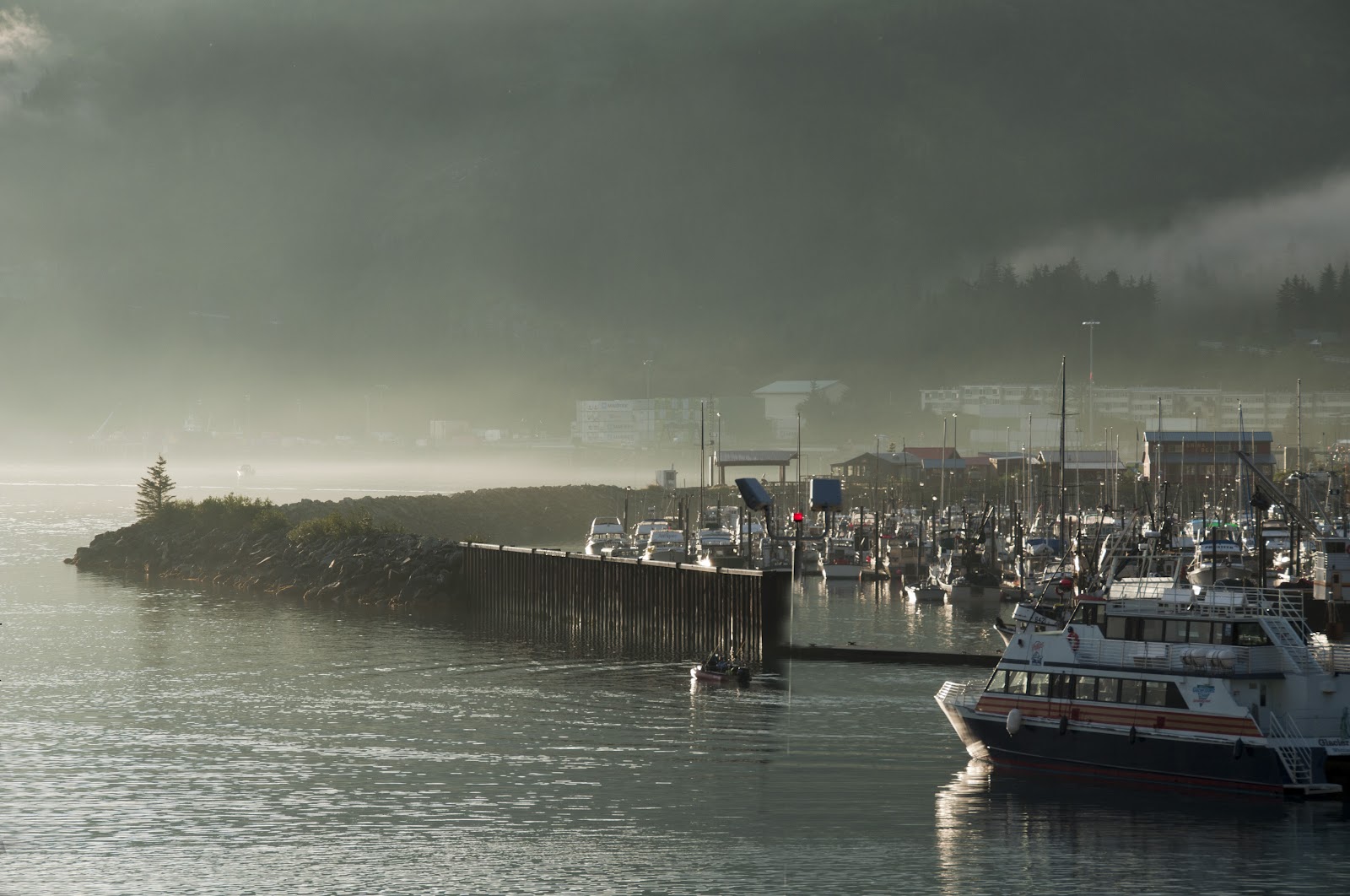
The disembarkation point of our cruise was Whittier which is 60 miles southeast of Anchorage.  As we stepped out of the cruise ship in early morning, stunningly beautiful Whittier harbor and nearby mountains veiled in fog greeted us.  Not far from the cruise terminal, there lies the 2.5 miles long Anton Anderson Memorial Tunnel in one lane shared by both cars and trains.  It is the second longest highway tunnel of North America (50 ft shorter than the Ted Williams+I-90 extension in Boston) and is the only land access of Whittier to the outside world through the Portage Glacier Highway. 


The short drive through the Portage Glacier Highway was breathtaking.  We in fact returned to the area a few days later for more photo shoots and hikes to see the lake and glaciers.  20 miles west, Portage Glacier road meets the Seward Highway which is a part of Alaska Route 1.  If you turn left and heads west-southwest, you can explore the heart of Kenai Peninsula.   Turning right and head north, you soon see Turnagain Arm to your left with Anchorage at the far north of the mouth of the Arm at more than 30 miles away.  Turnagain Arm is one of the about five dozen places in the world where one can see tidal bore. (but it is not nearly as impressive as the one at Qiantang River of China which has the world's largest bore - up to 30 ft high and moving at up to 25 miles per hour.)   During high tides, pods of Beluga whales or white whales (ok, it is a misnomer and is really more like dolphins) follow and chase the silver salmon all the way upstream from Cook Inlet.  It is not difficult to spot some of these cute mammals along the highway, one of the only two places in North America where you can watch Beluga whales in the wild.


Turnagain Arm northward
Alaska Fireweed

Turnagain Arm when low tide


Continuing north on Alaska Route 1 past Anchorage, a mere 30 miles out, one reaches Wasilla which is a small suburban town of Anchorage with less than 8,000 residents.   It is now internationally known, thanks to Sarah Palin who was its mayor from 1996 till 2002.  She was elected as the Governor of Alaska in 2006 and became the Republican Party nominee for Vice President in the 2008 election.  To boost her credential on international affairs, Sarah Palin had made the famous statement: "They're our next-door neighbors, and you can actually see Russia from land here in Alaska, from an island in Alaska." Although the statement was technically correct, it was such a stretch from her demonstrated intellects and experiences that the statement became a constant joke of her ignorance of foreign affairs. 

Picking up Alaska Route 3, aka the George Parks Highway after Wasilla and going north along the imposing Alaska Range at the west, one can enjoy a pleasant drive to Denali National Park 200 miles away.  The word "Denali" came from the native Athabaskan language.  It means "the high one", referring to the Mount Denali of the park.  It is also known as Mount McKinley, named after president William McKinley of Ohio in 1897.  Mount Denali is the highest mountain of North America.  Peaked at 20,327 ft, it is simply a gigantic piece of granite that was lifted up into the sky from Denali Fault as a result of tectonic activities over 10's of millions of years. 

Denali National Park and Reserve has more than 4 million acres in area and is the third largest national park of U.S.   Because of the low temperature and short growth seasons, Denali National Park has little wooded areas.  Instead, tundra at various elevations with beautiful fall colors covered much of the ground no matter at which directions you look.  There is only one Park Road of 91 miles long that takes one from the park entrance to the mining camp of Kantishna.  The first 15 miles is open to private vehicles.  The remaining 76 miles of narrow gravel road is only accessible by Park concessionary buses.  A round-trip bus ride with short stops along the way all the way to Kantishna would be a 12+ hours venture.   The reward though is the spectacular sceneries and possible encounters with wildlife – grizzly bears, mountain sheep, moose, and more.  One new thing I learned from watching a film at the visitor center was the most impressive camouflage I have ever seen.  Look at the photos below and compare the Willow Ptarmigans (the state bird of Alaska) in late Aug that we saw and a photo of a Ptarmigan in winter that I downloaded from Internet!   


More selected photos follow them below.  With a three-night stays, we barely scratch the surface.  Next time, we hope we have a better luck with the weather and have more time to hike at various parts of the park.

A lone grizzly bear
A lone visitor


Eielson Visitor Center
Wonder Lake


Mount McKingley seen from Alaska Route 1


Before I go, I should say a few words about food.  Material wise, you can’t go wrong with fresh local salmon and halibut.  But if you are not sure about the joint, simply order entrees that retain the original flavor as much as possible. We have had decent food at most of the places we visited including the café in the Denali Park.  We also had a wonderful outdoor lunch break and leisure walk at Talkeetna on the way to Denali from Anchorage.  It is a lovely small town with quite a few cozy restaurants.  I had Caribou Chili and a special Ale made with Fireweed honey.  With 9% alcohol, that Ale was the strongest beer I have ever had but is very good.  The Caribou Chili was nicely done too.  It didn't taste gamey as one might fear.   Perhaps it has something to do with the fact that restaurants in U.S., as required by law, can only serve game meats that are farm-raised? 

Talk to you soon!


Saturday, September 29, 2012

Cheat to Thrive


Recent news reports of large scale academic cheating at top schools like Stuyvesant High School in New York City and Harvard University have drawn a lot of attentions.  In the recent NY Times article Studies Find More Students Cheating, With High Achievers No Exception by Richard Perez-Pena,  Professor Donald L. McCabe of the Rutgers University Business School who is a leading researcher on cheating was quoted to say “There have always been struggling students who cheat to survive.  But more and more, there are students at the top who cheat to thrive.”  He may be right that there have been more reported incidents or such a trend indicated by surveys.  However, sorry to sound cynical, should we be surprised if there have always been people “at the top”, students or not, who cheat to thrive?

One finds a definition of cheat in Merriam-Webster Dictionary as a : to practice fraud or trickery
b : to violate rules dishonestly.  Wikipedia article on cheating gives it a broad definition:an immoral way of achieving a goal. It is generally used for the breaking of rules to gain advantage in a competitive situation. Cheating is the getting of reward for ability by dishonest means.”  

There are several critical words in these definitions that warrant closer examinations.  What is considered immoral?  Is it a function of particular community and time?  Who define the rules and how are rules upheld and enforced?   Are the criteria of cheating absolute or relative?  What if there is no reward involved?  What if the underlying situation is not competitive?  Is the same behavior now still considered cheating?

For the recent Harvard scandal (see NY Times article Harvard Says 125 Students May Have Cheated on Exam), the professor did tell the students that they must work alone in the take-home open-book, open-internet final exam.   When the professor saw the similarity of the answers in many of the papers submitted, he did the right thing and reported the incident to the administration who opened the investigation.  For the Stuyvesant High School scandal (see NY Times article Allegations of Widespread Cheating), the scandal became public when the Principal confiscated a student’s cell phone during a city language exam and uncovered evidences of widespread cheating. 

Are these students “cheat to survive” – to survive in a highly competitive environment?  Note even at Stuyvesant and Harvard, by definition, half of the students are below median in their class!  Since the cheats appeared to be “business as usual” to many of the students involved according to the reports, I would guess at least many of the offending students belong to the group of “cheat to thrive”.  

Thus a more sombering question is what is happening with our society as a whole?   Is there a trend of increasing moral delinquency especially among the elites?   Is this just a tip of the iceberg?    After all, these are not isolated incidents and students have not been the only ones caught cheating.  Only a little more than a year ago, 178 Atlanta public school teachers and principals were accused of altering students’ grades in high-stake standardized tests.  

As many have observed, technology and tool advances have made cheating easier.  Obvious example is cell phones with camera and texting.  Copy and paste features in word processing software allows people to lift others’ writings effortlessly.  Further, there are abundant resources online at our finger tips.  With powerful search engines, one can plagiarize any subject matter even at advanced levels.  All in all, the popularity and ease of sharing over Internet have eroded the time-honored respect for originality, authorship and ownership.  I have seen highly educated and accomplished adults lifting regularly others’ work in their communications without attributions.  While one may argue that there are no explicit or direct rewards in some of these cases, one cannot stop wondering what kind of role models and what effects would it have on next generations? 

Misguided promotion of group work in school is also a suspect.   Group work sometimes does degenerate into straightforward copying and sharing of final outputs and credit without division of work and responsibility.  To some, the lesson learned from team work is how to get more easy awards by taking others’ credits instead of the true meaning of collaboration that one plus one can be bigger than 2 and that it is the only way to work a complex problems effectively. 

Competition for reward and satisfaction is certainly a huge factor in inducing cheating behaviors, especially for the elites.  A famous example can be found in the NOVA program Secret of Photo 51 that details the history of Rosalind Franklin's contributions in the discovery of the double helix structure of DNA.  The 1962 Nobel Prize in Physiology or Medicine was given to James Watson, Francis Crick and Maurice Wilkins who, along with their Lab directors, knowingly neglected to mention that their successful discovery and breakthrough model was critically dependent on Franklin’s experimental results to which they had obtained access without her permission.   I am sure you have no problem finding plenty examples in politics and business world where people constantly dance between the fine legal and ethical lines.   In his Sept 24th New York magazine article Cheating Upwards, Robert Kolder had an in-depth profile about Nayeem Ahsan, the Stuyvesant High junior who was in the center of the recent cheating scandal.  Do you know what was his dream college?  Yes, it was Harvard.  Do you know what his dream career is?  It is investment banker.   Should we be surprised that there is less and less trust the public have on our political and business leaders? 

Why do people cheat?  I can think of many reasons and you can too: no one is watching, others do it (and I would be disadvantaged if I don’t), the reward is worth the risk of getting caught and the possible penalty if caught, the thrills and pleasure, help a friend in need, it won’t really hurt others, and because I can, just to name a few.  Sadly, cheating appears to be universal throughout human history in all civilizations.  Let us be honest.  A vast majority of us do have the temptation to cheat from time to time (Perhaps,  it comes from our survival and competitive instinct?).  Given that, and given that a dominating factor in cheating is how easy it is and how high the penalty is, the solution seems clear.  More transparent process, more safeguards, raise penalty and enforce the rules.  Success should be commended but cheat to thrive must not be tolerated.

Talk to you soon!